
Pests
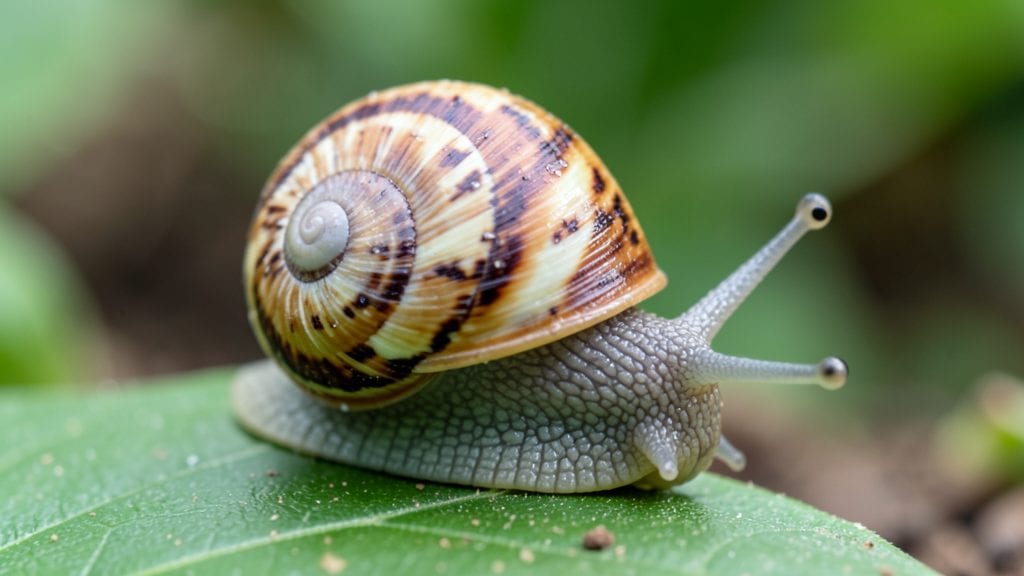
Understanding garden snail anatomy reveals how their spiral shell protects them, their muscular foot enables gliding movement, and retractable tentacles detect threats while humidity levels. The mucus trail they leave behind serves both mobility and moisture retention, while their radula efficiently scrapes plant surfaces.
These tiny creatures pack a lot of clever adaptations into their compact bodies.
The spiral shell isn't just for looks—it's a fortress made of calcium carbonate, growing with the snail through visible rings that mark their age. 🌟 Meanwhile, those two eyestalks aren't just for show: each has both eyes at the tips and chemoreceptors along their length to detect odors and vibrations, helping them avoid predators like birds and toads.
The radula, a toothed ribbon in their mouths, acts like nature's sandpaper, scraping through leaves with remarkable precision.
What's fascinating is how their anatomy works together—like the mucus trail they produce, which doubles as both a lubricant for movement and a moisture barrier to prevent dehydration. This dual-purpose secretion explains why you'll often find them active after rain or during humid nights.
Their muscular foot isn't just for sliding either; it can expand and contract to create suction, helping them climb vertical surfaces with surprising agility.
💡 In This Article
- How Garden Snail Anatomy Enables Defense and Feeding
- Identifying Snail Body Parts for Garden Pest Control
How garden snail anatomy enables defense and feeding
The garden snail's spiral shell is a marvel of biological engineering, constructed primarily from calcium carbonate secreted by the mantle—a specialized tissue lining the shell's interior.
This fortress-like structure isn't just protective; it grows with the snail through concentric rings that act like growth markers, with each ring representing approximately one month of development. The shell's coiled design provides 360-degree protection while minimizing weight, allowing the snail to retreat completely when threatened.
Interestingly, the shell's strength comes from its layered structure—similar to mother-of-pearl—with each new layer adding 10-15% more protection than the previous one.
At the top of the snail's head sit its two eyestalks, each topped with a pair of eyes that can detect movement up to 10 feet away.
But here's where it gets fascinating: these eyestalks also contain chemoreceptors along their length that can detect humidity gradients as subtle as 0.5% moisture change in the air.
This dual sensory system explains why snails become active after rain—their chemoreceptors detect rising humidity levels before their eyes even register the moisture.
The snail can retract its entire head and tentacles into its shell in under 0.3 seconds when threatened, a speed that makes them nearly impossible for birds to catch mid-retraction.
The radula, a ribbon-like structure lined with 10,000-20,000 tiny teeth, is nature's most efficient scraping tool. Each tooth is made of chitin and wears down in 24-48 hours, explaining why snails must constantly graze.
The radula operates like a conveyor belt, with new teeth constantly growing at the back while worn teeth are shed at the front.
This constant renewal allows a snail to scrape through 0.004 inches of plant tissue per minute—a seemingly small amount that adds up to significant damage over a growing season. The precision of this scraping action creates characteristic notched feeding patterns on leaves that gardeners often notice first.
Most intriguing is the mucus secretion, produced by specialized glands along the foot's underside. This slippery substance serves two critical functions: first, it reduces friction by 90%, allowing the snail to glide smoothly over rough surfaces.
Second, it forms a protective barrier that prevents dehydration by locking in moisture—this explains why snails are most active during high-humidity periods (above 70% humidity). The mucus also contains antimicrobial compounds that help prevent infections from microscopic cuts sustained during feeding.
What's remarkable is how this same mucus can harden when exposed to air, creating a temporary "glue" that helps snails climb vertical surfaces.
Here's what most people don't realize about this mucus: its chemical composition changes based on the snail's needs.
When moving quickly, the mucus becomes thinner and more watery (similar to maple syrup consistency), while during periods of rest or drought, it thickens into a gel-like substance that can remain moist for up to 12 hours.
This adaptability explains why snails can survive months without food if moisture levels remain adequate—a survival tactic that makes them particularly resilient pests in gardens.
The snail's muscular foot is another engineering marvel, capable of generating 0.5 pounds per square inch of pressure—enough to lift 50 times its body weight in short bursts.
This power comes from a unique muscle arrangement that allows the foot to expand and contract like a bellows, creating both forward motion and suction for climbing.
The foot's underside contains 10,000 microscopic papillae that distribute the mucus evenly, while the foot's edges have specialized cells that detect surface texture—helping the snail navigate complex terrain without vision. 💫
What ties all these adaptations together is their interconnected nature. For example, the shell's calcium requirements come from the same diet that the radula processes—leafy greens contain 0.5-1% calcium, which the snail absorbs through its digestive system to reinforce its shell.
Similarly, the mucus production is directly linked to the snail's hydration levels, which are monitored by those same chemoreceptors on the eyestalks.
This holistic design explains why garden snails are so effective at what they do: their anatomy represents a perfectly balanced system where every feature supports both survival and feeding.