Watering
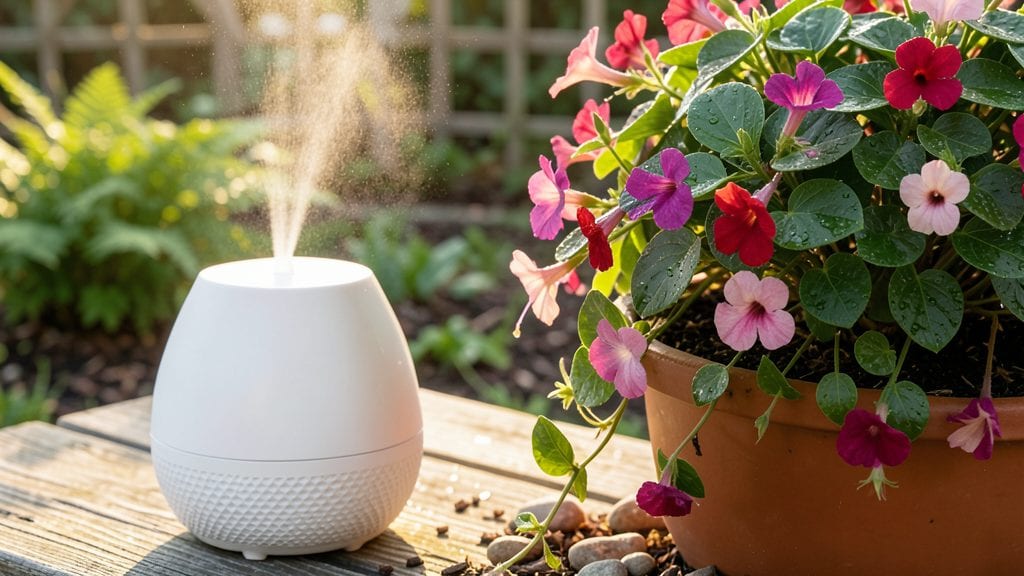
A cool mist garden humidifier maintains 40-60% humidity to support plant health, protecting leaves from dryness while preventing mold. Set it to 360-degree diffusion for balanced moisture and adjust output for different plants—tropicals thrive at higher levels, while succulents prefer drier air. Operate it for 6-12 hours daily based on your climate.
A cool mist humidifier works by dispersing fine water droplets into the air, which plants absorb through their leaves and roots. 🌿 This method mimics natural humidity levels in tropical environments, where many houseplants originate.
Unlike warm mist units, cool mist won’t scorch delicate foliage, making it safer for sensitive species like ferns and orchids. The 360-degree setting ensures even coverage, while adjustable humidity controls let you fine-tune for specific plant needs—critical for preventing both dehydration and fungal issues.
💡 In This Article
- How Humidity Levels Impact Plant Physiology
- Selecting the Best Cool Mist Humidifier for Indoor Gardens
How humidity levels impact plant physiology
Plants breathe through tiny pores called stomata on their leaves, which open and close to regulate moisture and gas exchange. When humidity drops below 40%, stomata struggle to retain water, causing them to close prematurely.
This disrupts photosynthesis by limiting CO₂ intake and forces the plant to expend energy to protect itself—leading to stunted growth or crispy leaf edges. 🌱 Cool mist humidifiers counteract this by maintaining optimal air moisture, allowing stomata to stay open longer for efficient nutrient absorption.
The science gets even more interesting when you consider transpiration—the process where plants release water vapor through their leaves. In dry air, transpiration accelerates, creating a "water deficit" that stresses the plant.
A 50% humidity environment reduces transpiration by about 30% compared to 30% humidity, giving roots time to replenish lost moisture. This is why tropical plants like calatheas wilt dramatically in dry conditions—their roots can't keep up with the rapid water loss.
Too much humidity (above 70%) creates its own problems by fostering fungal spores and bacterial growth. Cool mist systems prevent this by delivering fine, evenly dispersed droplets that evaporate quickly, unlike warm mist which can linger and promote mold.
The key lies in the 360-degree diffusion setting—it creates a uniform moisture blanket without creating damp pockets where pathogens thrive. 💧 For example, a fern collection needs 60-70% humidity to thrive, while a cactus collection can handle 30-40%—the same humidifier can serve both with proper zoning.
Relative humidity also affects photosynthesis directly. At 40-60% humidity, chlorophyll can absorb light more efficiently because the plant isn't diverting energy to water conservation. Below 30% humidity, photosynthesis drops by up to 15% as the plant prioritizes survival over growth.
This explains why indoor gardens in winter (when humidity naturally falls below 30%) often show yellowing leaves—a classic sign of photosynthetic stress.
Consider how different plant families evolved in varying climates: Orchids from tropical rainforests need 70-80% humidity to mimic their native environment, while Mediterranean herbs like rosemary thrive at 40-50%. The cool mist's adjustable output lets you replicate these conditions precisely.
For instance, placing a humidity tray under tropical plants while keeping succulents on a dry shelf demonstrates how one device can create microclimates within your garden. 🌿
The texture of leaves also reveals their humidity needs—thick, waxy leaves (like snake plants) indicate drought tolerance, while thin, delicate leaves (like peace lilies) signal high humidity requirements.
This physical adaptation explains why cool mist works better than traditional watering: it hydrates the air itself, not just the soil, creating an environment where all plant types can thrive without overwatering risks. 💫